Quick Summary
Seven materials cover nearly every attic: fiberglass batts, loose-fill fiberglass, cellulose, mineral wool, open-cell spray foam, closed-cell spray foam, and rigid foam board. They range from about 2.2 to more than 6 R-value per inch, so a higher number buys the same warmth in less depth, usually at a higher price. In the damp Pacific Northwest, how a material handles moisture and air leaks matters as much as its R-value, and the roof, the ventilation, and the existing insulation all shape the right choice. A professional assessment settles it faster and more reliably than comparing product labels.
Choosing among the types of attic insulation gets easier once you see that every material trades off R-value per inch, moisture behavior, cost, and how well it fits the shape of the attic, and that no single product wins on all four. A thick layer of loose-fill fiberglass and a thin layer of closed-cell foam can reach the same R-value while behaving very differently when a roof leak or a damp winter puts water into the attic.
In Whatcom and San Juan Counties, where long rainy seasons press on every part of a home’s envelope, the material also has to suit the roof above it, the ventilation beneath it, and whatever is already sitting between the joists. The seven materials below come with the R-value per inch listed by the U.S. Department of Energy, followed by how our team at Fly Guys Roofing narrows the choice for a specific house through our attic and crawlspace insulation service.
Fiberglass Batts and Rolls
Fiberglass blankets are the most common form of insulation in American homes, according to the Department of Energy, and they arrive as pre-cut batts or continuous rolls sized to fit standard joist spacing. Their R-value runs from roughly 2.9 to 3.8 per inch depending on the manufacturer and density, so reaching the R-49 to R-60 range recommended for an uninsulated attic in the Pacific Northwest takes a layer well over a foot deep.
Batts work best in a tidy, unobstructed attic with regular joist bays, and they perform poorly around wiring, bracing, and the irregular gaps that older homes tend to have. Gaps and compressed sections cut the real-world performance well below the number printed on the package, which is why a batt installation lives or dies on workmanship. Their strength is a low material cost and a long record of use.
Loose-Fill Fiberglass
Loose-fill fiberglass is blown across the attic floor with a machine and settles into an even blanket that wraps around framing, pipes, and cables. It carries a lower R-value per inch than batts, about 2.2 to 2.9, which means more depth is needed to reach a target, but the coverage is far more continuous than a patchwork of cut batts.
This is the material most often found in existing attics, which matters when a home is being upgraded, because new insulation can frequently be added over the old layer as long as the old layer is dry and clean. A professional assessment decides that, since damp or contaminated material has to come out first, and our insulation service includes removal of old or damaged insulation for exactly that reason.
Cellulose
Cellulose is loose-fill insulation made mostly from recycled paper and treated against fire and pests, and the Department of Energy lists it at about 3.6 to 3.8 R-value per inch. That density gives it a clear advantage over loose-fill fiberglass, since the same R-49 target needs roughly 13 inches instead of 17 to 22.
Because it packs tightly, cellulose also slows air movement through the attic floor more effectively than lighter fibers, and it can be dense-packed into enclosed cavities where blown fiberglass would not reach. The tradeoff is its relationship with moisture, since cellulose that gets wet slumps and dries slowly, so the roof overhead and the attic ventilation have to be sound before it goes in.
Mineral Wool
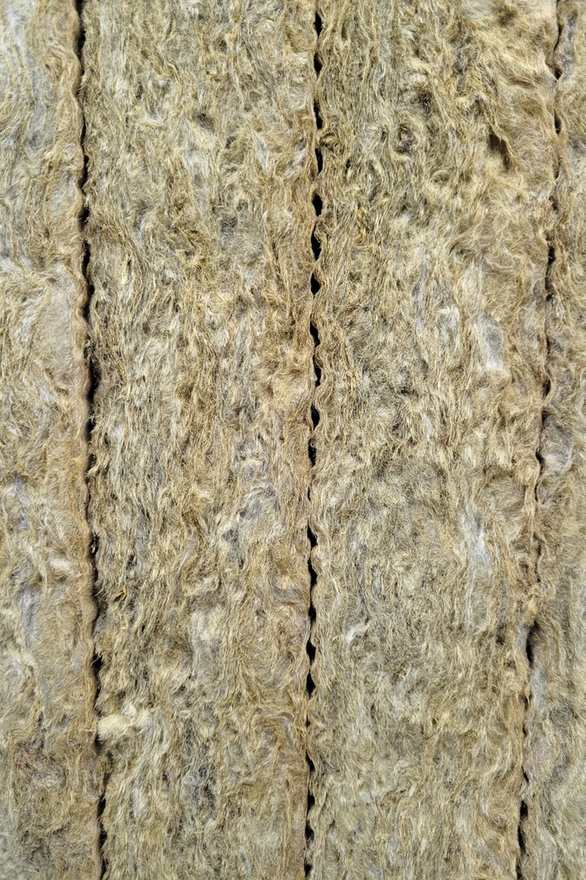
Mineral wool, sometimes called rock wool or slag wool, is spun from molten stone or industrial slag and sold as batts and rigid panels at about 4 to 4.2 R-value per inch. It resists fire and repels water better than most fiber insulation, and it holds its shape in a joist bay without sagging.
Those qualities make it appealing for attics with a history of dampness or for areas near chimneys and flues, and the higher R-value per inch saves depth in a shallow attic. It costs more than fiberglass and is denser to handle, so it tends to be chosen deliberately for a particular problem rather than as a default.
Open-Cell Spray Foam
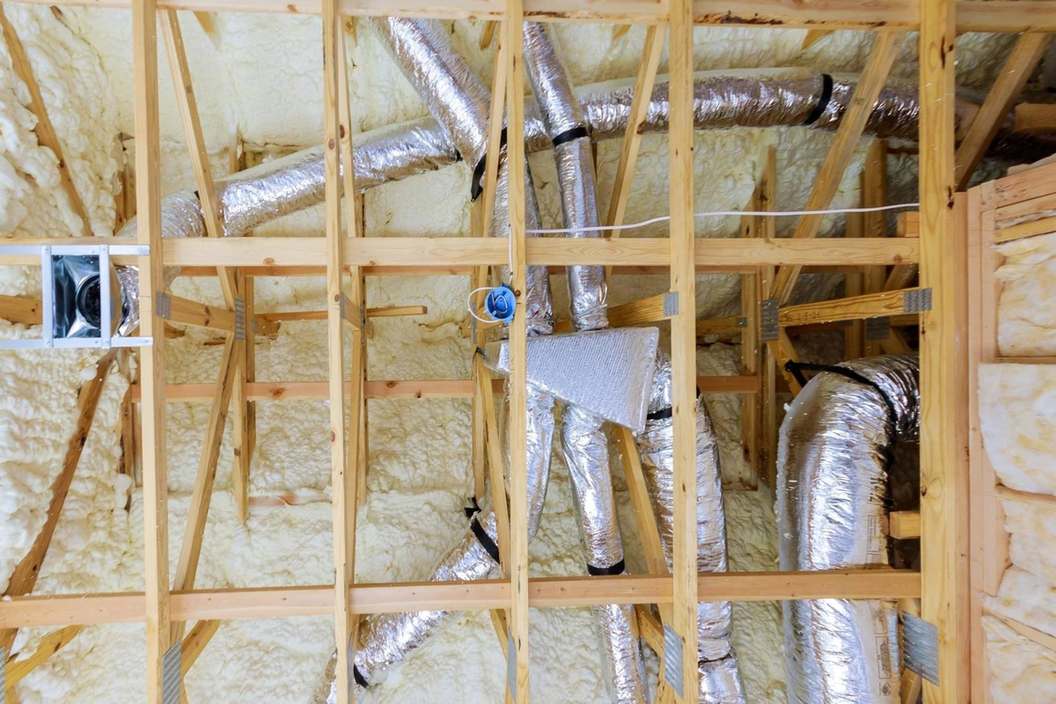
Open-cell spray foam is a two-part liquid that expands into a soft, airy foam, with an R-value of about 3.6 to 4.3 per inch. Its main strength is that it fills every crack and irregular gap while it cures, which turns insulation and air sealing into one step.
It is generally applied to the underside of the roof deck rather than the attic floor, and that choice converts the attic into an unvented, conditioned space, which changes how the roof dries and has to be designed that way from the start. Because it is a chemical product mixed and applied under pressure, it is professional work only, and the roof above it needs to be in excellent condition because a leak hidden behind foam is slow to find.
Closed-Cell Spray Foam
Closed-cell spray foam is the densest common option, rated at R-6 or more per inch, and it also acts as a vapor retarder and adds some rigidity to the surface it covers. A two-inch layer reaches R-12 or better, so it is the material of choice when depth is limited, such as in a vaulted ceiling or a low-slope assembly with little room for thicker products.
The price is the highest in this list, and like its open-cell cousin it commits the home to an unvented attic design if applied to the roof deck. In a region this wet, its resistance to water is a real benefit in crawlspaces and rim areas, where moisture from the ground is the main concern.
Rigid Foam Board
Rigid foam comes as panels, commonly four feet by eight feet, with R-values from about 3.8 to 6.8 per inch depending on the polymer and the facing. It is cut and fitted between or over framing, and it works well in places where loose material would not stay put, including attic access hatches, knee walls, and the foundation walls of a crawlspace.
Rigid board is seldom used to insulate an entire attic floor because it is labor-intensive to cut and seal at every joint, yet it solves problems the other materials cannot, particularly around hatches and kneewalls where air leaks quietly undo the work done elsewhere in the attic.
How to Narrow the Choice for Your Attic
The material is only one decision. The Department of Energy estimates that adding insulation to attics, floors, and crawlspaces, together with sealing air leaks, can trim heating and cooling costs by up to 15 percent, and the sealing half of that equation is easy to overlook. Warm indoor air leaking through ceiling penetrations, recessed lights, and bath fan ducts carries moisture into a cold attic, where it condenses on the underside of the roof deck, so air sealing and ventilation deserve as much attention as the insulation itself.
Existing conditions steer the choice as well. Wet or contaminated insulation has to be removed, an uneven or compressed layer may only need topping up, and an older roof near the end of its life is a reason to sequence the work carefully, since new insulation covering an unrepaired leak hides damage until it is expensive. These are judgment calls that depend on seeing the attic in person, which is why our free assessment starts with a look at the insulation already in place and how the attic and roof work together.
Why Attic Insulation Belongs With a Roofing Contractor
An attic is part of the roof system, and insulation placed without regard to the roof can trap moisture against the decking, block soffit vents, or cover a slow leak that has not yet shown on the ceiling below. Because we are roofers first, our team reads an attic the way it relates to the shingles, flashing, and underlayment overhead, and we handle the full range of attic and crawlspace insulation work, from assessment and air sealing to removing old material and installing new.
That connection also saves homeowners a second contractor visit when the roof needs attention. If the inspection turns up deteriorated decking or an aging covering, our roof replacement crews can address it on the same schedule, which keeps the insulation upgrade from being undone by a leak a year later. Cameron, in a 5-star review of a full roof and insulation replacement, said the crew “had the job complete in just 1 day”.
To find out which material fits your attic, you can request a free quote and we will take a look.
FAQs
What type of insulation is best for my attic?
No single material wins on every count, because each one trades off R-value per inch, moisture behavior, cost, and fit. Loose-fill fiberglass and cellulose suit many open attic floors, mineral wool suits damp spots, and spray foam suits tight or vaulted spaces. We look at the attic in person before recommending one.
Which type of attic insulation has the highest R-value?
Closed-cell spray foam has the highest R-value per inch among common materials, at R-6 or more, followed by rigid foam board, which reaches about R-6.8 at its best. Loose-fill fiberglass sits at the bottom of the range, near R-2.2 to R-2.9 per inch. Higher R-value per inch saves depth, but the best choice also depends on moisture, budget, and the shape of the attic, so a professional assessment gives a more useful answer than a ranking.
Can new insulation go over old insulation in my attic?
Often it can, provided the existing layer is dry, clean, and free of pests or mold, and provided the roof above it is not leaking. Damp, compressed, or contaminated material has to be removed first because it will not perform and can hide problems. Our team assesses the layer already in place before recommending whether to add to it or replace it.
Does attic insulation affect my roof?
Yes, because insulation changes how heat and moisture move through the attic, and both of those act on the roof deck. Too little insulation lets warm air escape and condense under the roof, while blocked vents trap humidity. Getting the insulation, air sealing, and ventilation to work together protects the roof and the home, which is one reason roofers are well placed to handle the work.
Do you install insulation in Bellingham and the San Juan Islands?
We serve homeowners across Whatcom and San Juan Counties, and our attic and crawlspace insulation service covers installation and upgrades, air sealing, removal of old or damaged material, and crawlspace insulation with vapor barriers. A free assessment is the first step, and we will recommend a solution that fits the home and the roof above it.
Call (360) 317-5027 to check availability with Fly Guys Roofing.